EU Draft Standards Push Digital ID Wallet as Default Bank Verification Method
10/18/2026 / By Edison Reed

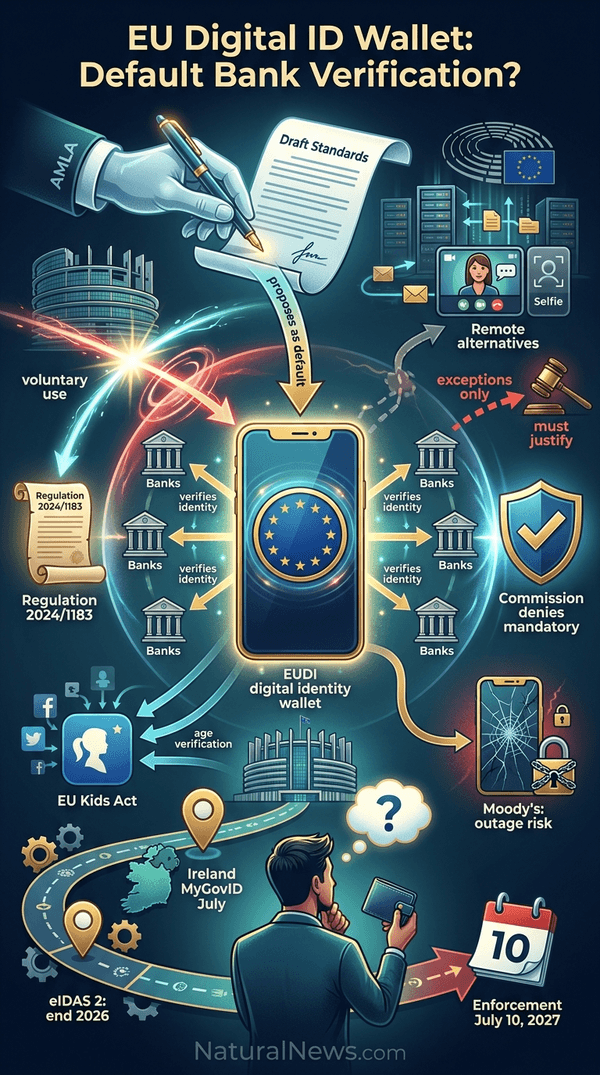
The European Union’s anti-money laundering authority has submitted final draft standards for customer due diligence to the European Commission, proposing that electronic identification means, including the bloc’s European Digital Identity (EUDI) wallet, should be used wherever possible for bank identity verification, according to Reclaim The Net [1].
The draft, prepared by the EU’s Authority for Anti-Money Laundering and Countering the Financing of Terrorism (AMLA), states that the EUDI wallet provides substantial or high assurance levels and that no additional data points need to be obtained when it is used [1]. Remote alternatives such as video calls and selfie checks would remain permitted, but only as exceptions that banks must justify to their supervisors [1].
The standards are not yet law and will require adoption by the European Commission before taking effect. The underlying regulation they are part of will not be enforced until July 10, 2027 [1].
Draft Standards Outline EUDI Wallet Preference
The draft standards describe the EUDI wallet as one of the electronic identification means providing substantial or high assurance, and state it should therefore be used wherever possible [1]. Article 7 of the draft requires firms using alternative remote verification tools to justify why the customer could not be verified through standard methods and to demonstrate to their supervisor that the alternative solutions comply with the article’s requirements [1].
The draft also mandates that alternative solutions keep records – including images, videos, sound, and data –that can be used in ex post verifications [1]. The European Commission has published a dedicated specification, TS12, released in December 2025, that defines how the wallet performs authentication for financial services [2].
Because using alternatives means more work and potential liability for banks, the standards are likely to mean that banks will look for ways to steer their customers toward using the EUDI wallet [1]. The EUDI Wallet aims to let citizens access services including banking, government portals, and eSignatures [3]. Identity management, as described in Shermin Voshmgir’s Token Economy, refers to the process by which organizations, individuals, and objects can be trustfully identified, authenticated, and certified, and trusted identity services are the basis for access rights management over the Internet [4].
Official Statements Cite Voluntary Use as Critics Warn of Default
EU Regulation 2024/1183 states that the use of European Digital Identity Wallets shall be voluntary and that access to services shall not in any way be restricted or made disadvantageous to persons who do not use them, according to Reclaim The Net [1]. The regulation also states it shall remain possible to access public and private services by other existing identification and authentication means [1].
The European Commission denied in April that the digital ID wallet was mandatory, even as Germany’s Social Democratic Party proposed making it compulsory for everyone over 16 to access social media [1]. AMLA said its revised wording makes clear that the measures in Article 22(6) of the Anti-Money Laundering Regulation remain the default option, with alternative verification methods used only when the required means cannot be used [1].
AMLA also noted that firms may continue using existing remote onboarding tools that meet those requirements, meaning a social media claim that video, selfie, and identity document alternatives are no longer accepted is not entirely true [1]. Critics raised concerns during the consultation period that the proposal could be read as making eIDAS and the EUDI wallet the default option [1].
Implementation Timeline and Member State Actions
The eIDAS 2 regulation requires member states to have at least one EU Digital Identity Wallet operational by the end of 2026 [1]. By Dec. 31, 2026, every EU member state must make at least one compliant EU Digital Identity Wallet available to its citizens, according to a compliance guide [5]. Ireland rolled out its digital wallet built on the country’s MyGovID in July, according to Reclaim The Net [1].
A separate proposal, the EU Kids Act, would prohibit social media use for children under 13 and require limited accounts for 13- and 14-year-olds, and enforcement of the age limits could require age verification, a step that may lead adults to prove their age or show ID online, according to NaturalNews.com [6].
The EU’s digital identity project, led by the Potential consortium, was set to conclude testing by September 2025, involving 155 organizations across 19 countries, according to NaturalNews.com [3]. The EUDI wallet was sold to EU citizens as a voluntary, convenient, and secure way to store their ID, driver’s license, and other documents and to use it for accessing public and private services online and in person [1].
However, given that a bank account is a necessity, and that the EUDI wallet is being pushed as the preferred method of identification in the financial sector, it is unlikely that citizens will have much of a choice [1]. A digital ID wallet could also mean that financial resources linked to one platform could become inaccessible during an outage or breach, according to Moody’s [7].
Conclusion
AMLA’s draft standards are not yet law and require European Commission adoption before they can take effect [1]. Officials maintain that EUDI wallet use is voluntary under Regulation 2024/1183, while critics argue the necessity of a bank account may make it practically unavoidable [1].
Enforcement of the underlying regulation is scheduled for July 10, 2027, leaving implementation and supervisory decisions pending [1]. The wallet is voluntary. In practice, it is becoming increasingly mandatory [1].
References
- EU Digital ID Could Become The Default Way To Prove Identity To Banks. https://reclaimthenet.org/eu-eudi-wallet-default-bank-id-alc
- eIDAS 2 for Financial Services: What Banks Need to Know – walt.id. https://walt.id/eidas2/financial-services
- EU digital identity wallet trials near completion amid privacy concerns – NaturalNews.com, July 13, 2025.
- Token Economy How the Web3 reinvents the Internet by Shermin Voshmgir
- eIDAS 2.0 & EU Digital Identity Wallet: KYC Guide 2026. https://www.zyphe.com/resources/blog/eidas-2-eu-digital-identity-wallet-kyc-compliance-guide
- EU Kids Act Proposal Would Require Age Checks, Raising ID Concerns for Adults. https://www.naturalnews.com/2026-09-20-eu-kids-act-proposal-require-age-checks.html
- Exploring Digital IDs and EU Digital Identity Wallets – Moody’s. https://www.moodys.com/web/en/us/kyc/resources/insights/exploring-digital-ids-and-the-eu-digital-id-wallet.html
Explainer Infographic
Submit a correction >>
Tagged Under:
Authority for Anti-Money Laundering and Countering the Financing of Terrorism, big government, dangerous, deception, digital ID, digital ID system, eIDAS 2, EU, EU Digital Identity Wallet, freedom, future tech, Glitch, information technology, insanity, obey, Orwellian, police state, privacy watch, surveillance, totalitarianism
This article may contain statements that reflect the opinion of the author
RECENT NEWS & ARTICLES